
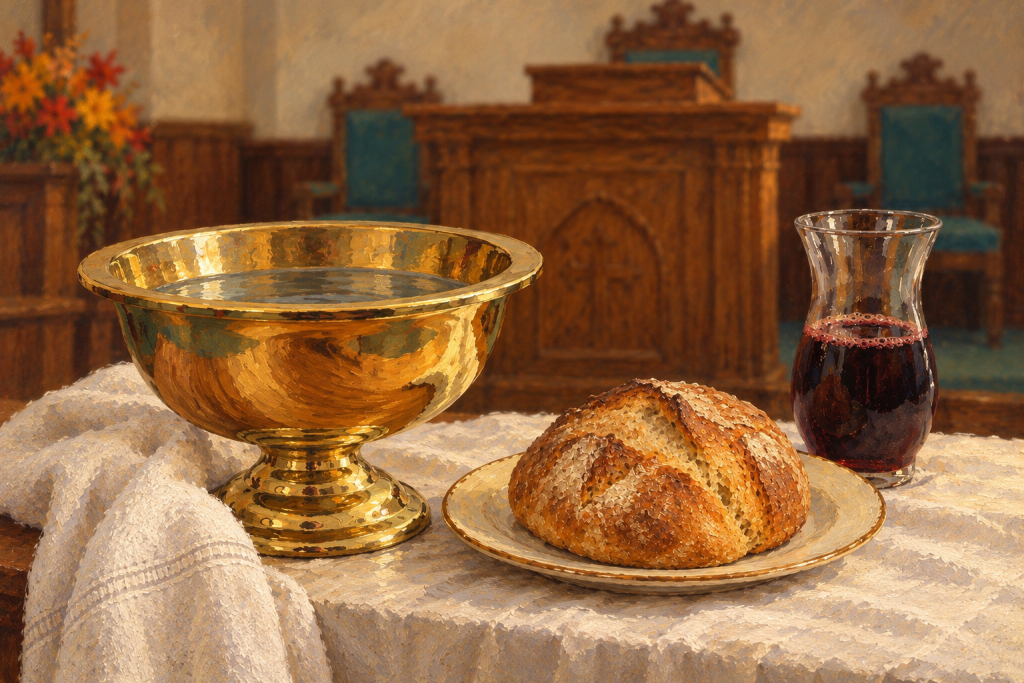
The Sacraments
Q. 92. What is a sacrament?
A. A sacrament is an holy ordinance instituted by Christ; wherein, by sensible signs, Christ, and the benefits of the new covenant, are represented, sealed, and applied to believers.
Westminster Shorter Catechism, Q. 92
Baptism
Q. 94. What is baptism?
A. Baptism is a sacrament, wherein the washing with water in the name of the Father, and of the Son, and of the Holy Ghost, doth signify and seal our ingrafting into Christ, and partaking of the benefits of the covenant of grace, and our engagement to be the Lord’s.
Westminster Shorter Catechism, Q. 94
Baptism marks a person’s admission into the visible church. It is administered once, ordinarily in the presence of the worshipping congregation.
Adults
Those who come to faith in Christ and have not been baptized are baptized upon a credible profession of faith, after instruction in the meaning of the sacrament, the Christian faith, and the privileges and responsibilities of church membership.
Children of Believers
Presbyterians baptize the children of believers as well. Under the Old Testament, God commanded that the sign of His covenant, circumcision, be given to the children of His people (Genesis 17:7, 10). In the New Testament, baptism takes the place of circumcision as the sign of the covenant (Colossians 2:11–12), and the promise remains “for you and for your children” (Acts 2:38–39). The apostles baptized whole households (Acts 16:15, 33; 1 Corinthians 1:16). Baptism does not save a child; it marks the child as belonging to the Lord’s covenant people and calls him or her to faith in Christ.
Parents who wish to have a child baptized should speak with the pastor, who will meet with them beforehand to explain the vows they will take.
The Lord’s Supper
Q. 96. What is the Lord’s Supper?
A. The Lord’s Supper is a sacrament, wherein, by giving and receiving bread and wine, according to Christ’s appointment, his death is showed forth; and the worthy receivers are, not after a corporal and carnal manner, but by faith, made partakers of his body and blood, with all his benefits, to their spiritual nourishment, and growth in grace.
Westminster Shorter Catechism, Q. 96
“For as often as you eat this bread and drink the cup, you proclaim the Lord’s death until he comes” (1 Corinthians 11:26). In the Supper, Christ feeds His people. The bread and wine are not changed into His body and blood, nor are they bare reminders; by faith, through the work of the Holy Spirit, believers truly receive Christ and all His benefits.
How Often Do We Celebrate the Lord’s Supper?
Our current practice at Seven Springs is to observe the Lord’s Supper quarterly, ordinarily on the second Sunday of February, August, and November, and the third Sunday of May.
This quarterly observance has been part of the historic practice of our congregation. At present, the Session is discussing the frequency of the Supper and considering whether a more frequent observance would better serve the congregation and reflect the place Christ has given the sacrament in the life of His Church.
Do You Use Wine or Grape Juice?
Our current practice is to use grape juice in the Lord’s Supper.
The Session is also reviewing this practice as part of a broader consideration of the administration of the sacrament. We are seeking to think carefully and biblically about how the Supper should be observed, including the elements used, while maintaining pastoral care for the congregation.
Who May Come to the Table?
The Lord’s Supper is for those who have professed faith in Jesus Christ, have been baptized, and are members in good standing of a church that faithfully preaches the gospel. Before the Supper, the pastor will explain the invitation and the warning that Scripture gives (1 Corinthians 11:27–29). If you are visiting and are not sure whether you should take part, you are welcome to let the elements pass and to speak with the pastor or an elder afterward.