
Baptism
Baptism is one of the two sacraments Christ gave to His Church. A sacrament is not merely a symbol that reminds us of something we believe; it is a holy ordinance instituted by Christ in which visible signs represent and seal the promises of the covenant of grace.
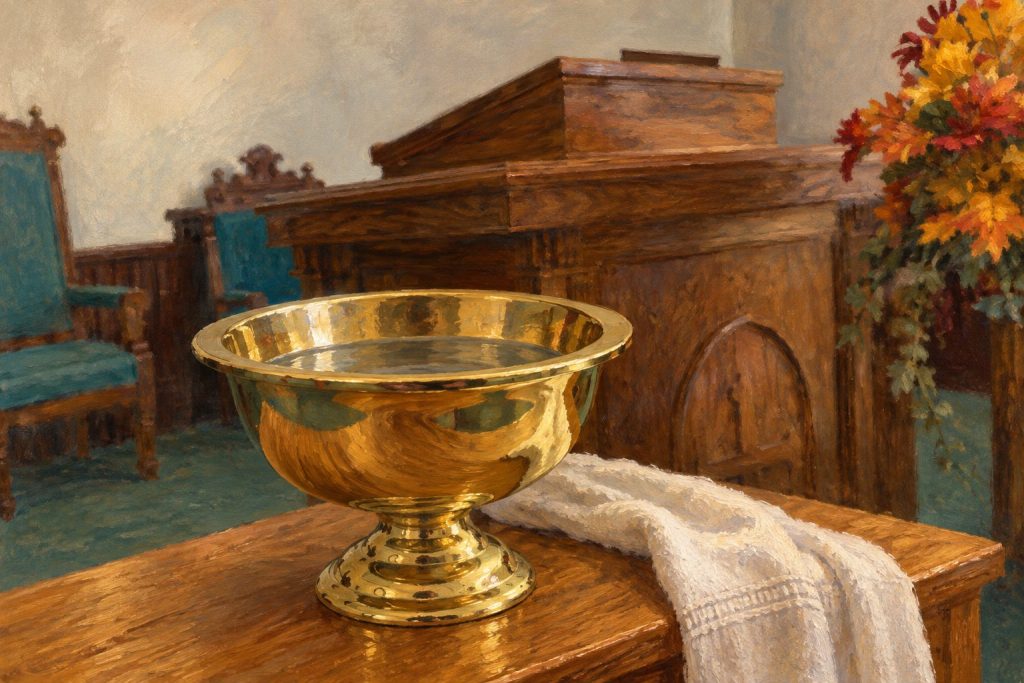
In baptism, ordinary water is used in the name of the Father, the Son, and the Holy Spirit. The water does not save us, nor does baptism automatically regenerate the person baptized. Rather, baptism points beyond itself to the cleansing from sin, union with Christ, and new life that are found only in Him.
Q. 94. What is baptism?
A. Baptism is a sacrament, wherein the washing with water in the name of the Father, and of the Son, and of the Holy Ghost, doth signify and seal our ingrafting into Christ, and partaking of the benefits of the covenant of grace, and our engagement to be the Lord’s.
Westminster Shorter Catechism, Q. 94
Baptism and the Visible Church
Baptism is also the sacrament of entrance into the visible Church. Christ does not save isolated individuals and leave them to themselves. He gathers a people, places them in His Church, gives them His Word and sacraments, and places them under the care and oversight of His appointed shepherds.
That is why baptism is ordinarily administered publicly in the gathered Church. It marks a person as belonging to the visible covenant community and places upon him or her both the promises and claims of God.
Why Do Presbyterians Baptize Children?
Presbyterians baptize both those who profess faith in Christ and their children because we believe the covenant of grace runs continuously through the Old and New Testaments.
When God established His covenant with Abraham, He promised, “I will establish my covenant between me and you and your offspring after you” (Genesis 17:7). The covenant sign was therefore placed not only upon Abraham after he believed, but also upon his children.
The coming of Christ does not narrow the covenant promise. Instead, it expands outward to the nations. Peter uses the same covenant language at Pentecost: “The promise is for you and for your children and for all who are far off, everyone whom the Lord our God calls to himself” (Acts 2:39). Paul likewise connects circumcision and baptism in Colossians 2:11–12. We therefore understand baptism as the New Testament covenant sign corresponding to circumcision under the old covenant.
That does not mean circumcision saved a Jewish child, and neither does baptism save a Christian child. Scripture has always taught that salvation is by grace through faith. The outward sign points to the inward reality that only the Holy Spirit can give.
Baptism of Adults and Children
Those who come to faith in Christ and have never received Christian baptism should be baptized upon a credible profession of faith.
The children of believers are also to receive baptism because they belong to the visible covenant community. They are therefore raised not as outsiders whom we hope may someday become connected to the Church, but as covenant children who are under the teaching, prayers, discipline, and pastoral care of Christ’s Church.
We pray that every baptized child will personally embrace Christ by faith and come to possess the blessings signified in baptism.
This does not mean that baptism automatically saves a child, nor that a baptized child does not need personal faith in Christ. Salvation has always been by grace through faith. Baptism identifies the child with the visible covenant community, places God’s promises and claims before him or her, and calls parents and the Church to raise that child in the nurture and admonition of the Lord.
Questions about Baptism
Have more Questions? Contact us!
Why do you baptize infants?
Because we believe God’s covenant promises include believers and their children. Peter’s Pentecost sermon uses the familiar covenant language: “the promise is for you and for your children” (Acts 2:39). We therefore see baptism not merely as a testimony of what we have done, but first as God’s covenant sign placed upon His visible people. The children of believers are part of the visible Church and should receive the sign of that covenant.
Does baptism save?
No. The water itself does not regenerate, justify, or save. Baptism signifies and seals the benefits of Christ and His covenant, but those benefits are received only through faith. A baptized child must still repent and believe the gospel, just as every adult must. Our confidence is never in the act of baptism itself, but in Christ to whom baptism points.
If I was baptized as an infant, do I need to be baptized again?
No. Christian baptism is administered once. Scripture speaks of “one Lord, one faith, one baptism” (Ephesians 4:5), and the Westminster Confession teaches that baptism is not to be repeated (WCF 28.7). If there is a question about whether a previous baptism was a valid Christian baptism, the Session can help you consider the circumstances.
Why do you pour or sprinkle instead of requiring immersion?
The amount of water is not what gives baptism its meaning. At Seven Springs we administer baptism by pouring or sprinkling, in keeping with historic Presbyterian practice. The Westminster Confession states: “Dipping of the person into the water is not necessary; but baptism is rightly administered by pouring or sprinkling water upon the person” (WCF 28.3). We do not re-baptize someone simply because a previous valid Christian baptism used a different mode.