
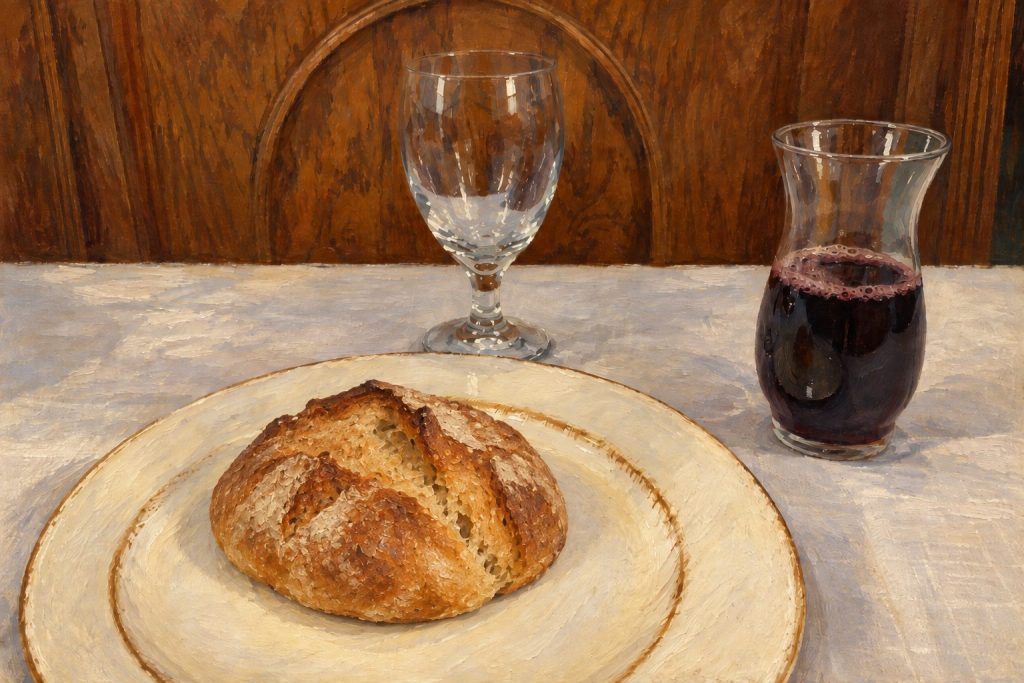
The Lord’s Supper
The Lord’s Supper is not merely a memorial meal. It certainly calls us to remember Christ’s death, but Scripture and the Reformed confessions teach that believers also truly receive spiritual nourishment through communion with the risen Christ.
Q. 96. What is the Lord’s Supper?
A. The Lord’s Supper is a sacrament, wherein, by giving and receiving bread and wine, according to Christ’s appointment, his death is showed forth; and the worthy receivers are, not after a corporal and carnal manner, but by faith, made partakers of his body and blood, with all his benefits, to their spiritual nourishment, and growth in grace.
Westminster Shorter Catechism, Q. 96
A Sign and a Seal
The Lord’s Supper is first a sign. The bread and the cup visibly proclaim the death of Christ. As Paul writes, “as often as you eat this bread and drink the cup, you proclaim the Lord’s death until he comes” (1 Corinthians 11:26).
But the Supper is also a seal. God confirms to believing recipients the promises of the gospel. Christ gave Himself for His people, and in the Supper He strengthens their assurance that the blessings purchased by His death truly belong to them.
Is Christ Really Present?
Yes—but not physically in the bread and wine. We do not believe that the bread and wine cease to be bread and wine or become Christ’s physical body and blood. Nor do we believe the Supper is a repetition of Christ’s sacrifice. Christ offered Himself once for all.
But neither do we believe Christ is absent from the Supper. By the Holy Spirit, believers truly commune with the risen Christ and feed upon Him by faith. His bodily presence remains in heaven, but by His Spirit He is genuinely present with His people and spiritually nourishes them.
Past, Present, and Future
The Lord’s Supper directs us in three directions:
- Backwards: we remember Christ’s once-for-all death for sinners.
- Presently: we enjoy communion with Christ and with one another as His body.
- Forward: we proclaim His death “until He comes” and anticipate the marriage supper of the Lamb.
So the Supper is not simply remembering something that happened long ago. It is a present means of grace and a foretaste of the feast to come.
Who Should Come to the Table?
The Lord’s Supper is not given indiscriminately to everyone present. Scripture instructs those who partake to examine themselves, discern the body, repent of sin, and feed upon Christ by faith.
For that reason, the Table is for communicant Christians—those who have made a credible profession of faith, received baptism, and been admitted to the Lord’s Table under the oversight of Christ’s Church.
Baptized covenant children are non-communicant members until they are able to profess faith and examine themselves. The Westminster Larger Catechism distinguishes baptism, which is administered once and even to infants, from the Lord’s Supper, which is administered repeatedly to those capable of self-examination (WLC 177).
Questions about the Lord’s Supper
Have more Questions? Contact us!
Do you use wine or grape juice?
Our current practice at Seven Springs is to use grape juice. The Session is presently reviewing this practice, together with other aspects of how we administer the sacrament, and is considering the use of wine while also providing for those who should abstain from alcohol. Until the Session makes any change, grape juice remains our practice.
How often do you celebrate the Lord’s Supper?
Our current practice is quarterly: ordinarily on the second Sunday of February, August, and November, and on the third Sunday of May. Quarterly communion has long been part of the practice of our congregation. The Session is presently considering whether the Lord’s Supper should be celebrated more frequently, so this schedule reflects our current practice rather than a conviction that quarterly observance is the only biblical frequency.
May I come to the Lord’s Table?
The Lord’s Supper is for baptized Christians who have made a credible profession of faith and have been admitted to the Table as communicant members of Christ’s Church. Visitors who are members in good standing of a Bible-believing evangelical church are welcome to commune with us, subject to the invitation and fencing of the Table given during the service. If you are unsure whether you should partake, please speak with the pastor or one of our elders before the service.
May children partake of the Lord’s Supper?
Baptized children are members of the visible Church and receive the Church’s care, teaching, and pastoral oversight. The Lord’s Supper, however, is given to those who can discern the body, examine themselves, and profess their faith in Christ (1 Corinthians 11:27–29). For that reason, covenant children begin receiving the Supper after they make a credible profession of faith and are examined and admitted to the Table by the Session. We therefore practice infant baptism, but not infant communion.